/
For the complete documentation index, see llms.txt. This page is also available as Markdown.

On this page
Footnotes
Footnotes allow readers to reference additional information without cluttering the main content.
Compact footnotes
Quarkdown introduces a compact [^label: definition] syntax that allows you to define footnotes directly at their reference point.
Example 1
This is a footnote reference[^first: This is the definition.],
and another one[^second: This is another definition.].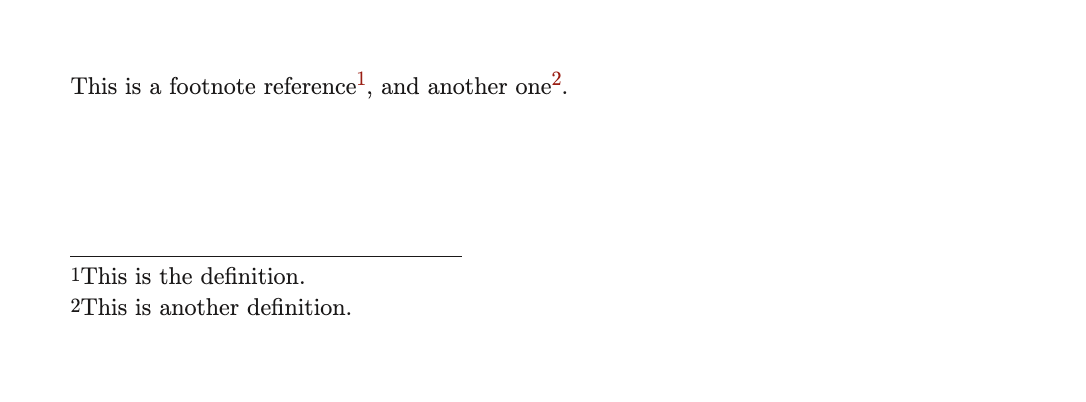
Named footnotes can be referenced multiple times.
Example 2
This is a footnote reference[^first: This is the definition],
and another one[^first].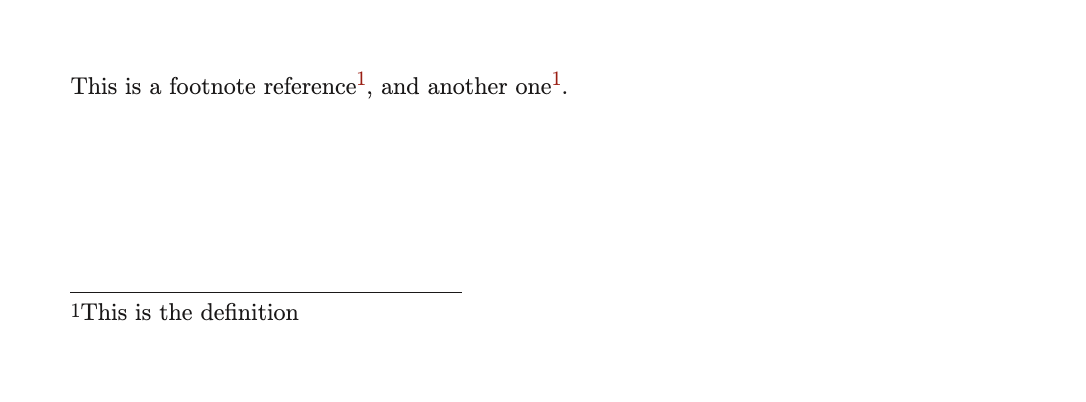
Definitions can include inline formatting.
Example 3
This is a footnote reference[^first: This is the **definition**.]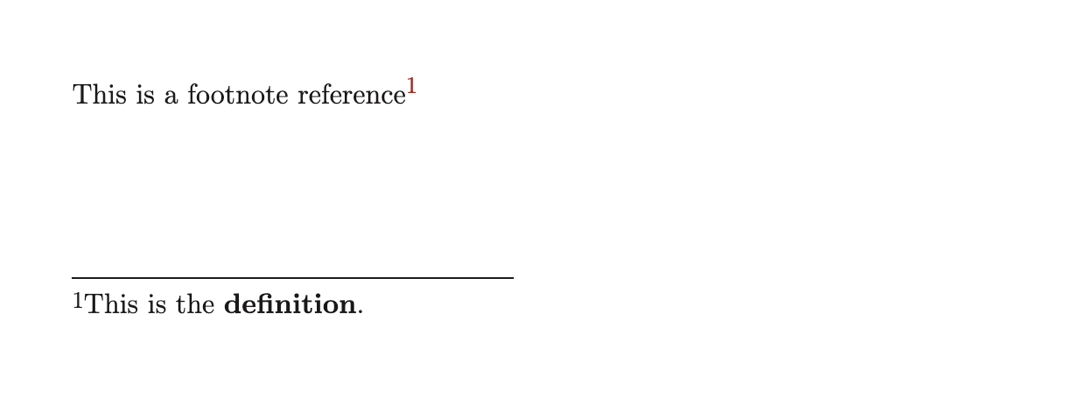
Anonymous footnotes
When an inlined footnote does not need to be referenced elsewhere, you can omit the label to create an anonymous footnote.
Example 4
This is a footnote reference[^: This is the definition.],
and another one[^: This is another definition.].
Standard footnotes
Quarkdown also supports the standard footnote syntax provided by many Markdown flavors.
This approach is more verbose but allows for a clean separation between the footnote reference and its definition, reducing clutter in the main text.
This is a footnote reference[^1].

[^1]: This is the definition.
Inline formatting is also supported in the definition:
[^1]: This is the **definition**.Long definitions can span multiple lines. Indentation is not significant:
[^1]: This is
      the definition.
When you have multiple footnotes, separate the definitions with at least one blank line:
This is a footnote reference[^first], and another one[^second].

[^first]: This is the definition.

[^second]: This is another definition.
Multiple references to the same footnote label are allowed, and they all point to the same definition:
This is a footnote reference[^first], and another one[^first].

[^first]: This is the definition.
The footnote label can be any string, and the definition can appear anywhere in the document:
[^first]: This is the definition.

This is a footnote reference[^first], and another one[^second].

[^second]: This is another definition.
Numbering
Footnotes are numbered by default with decimal numbers, starting from 1. To apply a different numbering style, such as Roman numerals, use the .numbering function. See Numbering for more information.
Example 5
.numbering
    - footnotes: i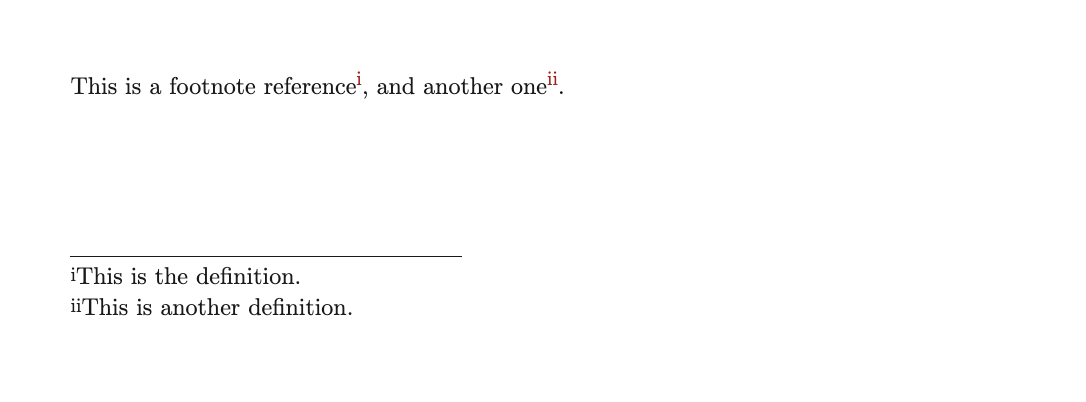
Footnotes are numbered incrementally across the subdocument. Page-level numbering is not supported yet.
Display
Footnotes render differently depending on the document type. See Document types for more information.